Sama Ooryad, Yeganeh Khoie, and Nastaran Saremy
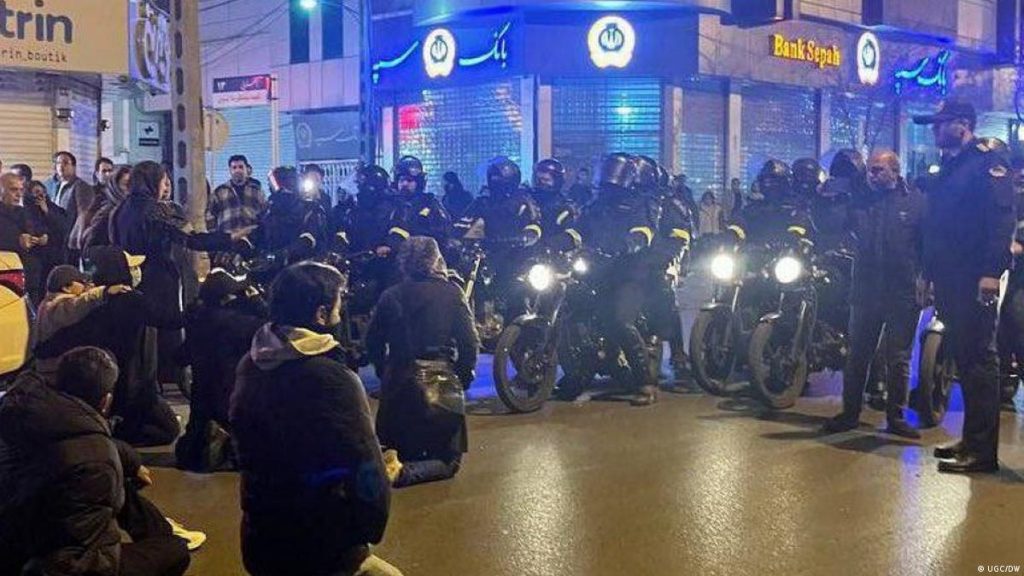
1. With the continuation of the Islamic Republic’s monetary and currency policies, rentier capitalism, and the intensification of crises of reproduction and accumulation in Iran, a new phase of protests was both likely and predictable. By virtue of its very origins, the bazaar cannot represent the dispossessed classes, and for this reason many initially regarded the protests with hesitation and silence. Although the presence of bazaar merchants diminished—albeit temporarily—following the government’s proposed policy changes, a more precise reading of the blanket term “bazaar tradespeople,” and its differentiation from mega-capitalists, allows us to discern the precarious position of small shopkeepers, retail workers, and precarious traders as integral to these protests.
Yet as we move forward, what sustains the protests is no longer primarily tied to currency fluctuations or access to financial facilities in the conventional logic of the market. Rather, it is oriented toward the crisis of social reproduction and livelihoods, and beyond that, toward a protracted crisis of political governance—one trapped in a cycle of repression and chronic inefficiency. This crisis has intensified following the twelve-day war and the further erosion of the regime’s capacity to reproduce authority and legitimacy.
A broad spectrum of political forces—including republicans, feminists, the left, and other anti-authoritarian tendencies—have refrained, with considerable hesitation, and anxiety, from taking positions or intervening in the current situation due both to their misalignment with some of the protesters’ slogans and to the precarious, high-stakes context produced by the most recent wave of foreign interventions across the globe. These forces—much like their counterparts on the opposite end of the political spectrum—are neither genuinely organized nor equipped with a coherent program to concentrate their dispersed capacities, at least in specific arenas where they could exert tangible influence. In the current volatile, contradictory, and high-risk condition, what modes of communication can anti-authoritarian forces adopt to engage society and dispersed social actors? How should we understand the crisis of political and civil efficacy in this post-movement, post-war condition, and how might a dialogue toward overcoming it be initiated? These fundamental questions appear to have been eclipsed amid the overflow of hasty and impulsive online debates.
2. Perhaps a problematic legacy of the 1401 (2022) protests was the emergence of leaders who sought to form coalitions in the diaspora and succeeded in mobilizing significant numbers of people, only to ultimately abandon the aspirations of the uprising one by one, each forming alliances—explicitly or implicitly—with imperial powers- those very powers that would attack Iran three years later. Discursively, the Jina (Woman, Life, Freedom) movement also failed to articulate a sufficiently expansive horizon of emancipation (on a national level). The breadth of internal repression left little room for marginalized forces to breathe, and many prominent activists associated with the movement ultimately became so-called “regime-change advocates” whose demands aligned more closely with right-wing and even pro-war forces than with the emancipatory ideals of the uprising.
The pronounced dominance of middle-class origins and voices in the post-Jina period constitutes one of the movement’s undeniable impasses. The prevailing top-down approach rooted in this social base being largely reformist, capitalist, and centered on bourgeois rights signals a deadlock that came to dominate the post-Jina landscape, despite the early multiplicity of voices from the margins during the uprising. This approach predates the uprising itself. The celebrity-centric logic and the media spectacle it fostered have obstructed emancipatory horizons in the post-Jina era. One recent example is the BBC Persian documentary Taraneh, broadcasted only days before the latest round of protests in Iran, which sparked a wave of online attention. Through a nostalgic outpouring of images, it sacralised and heroized activism in the 1401 protests in a celebrity-driven manner. Taraneh is but one manifestation of a dominant, commodified culture that imagines freedom and emancipation only for particular classes and groups. A thorough analysis of post-Jina media and celebrity-centered waves requires a separate discussion. Nonetheless, the widespread adulation and celebrity-centered glorification surrounding this documentary and similar recent examples underscore how dominant forces in the post-Jina period once again managed to marginalize—or appropriate—the original class-based origins, representations, and demands that emerged from the 1401 protests.
3. Independent forces and feminist activists, both inside and outside Iran, have sought to narrate and make visible the voices and demands of marginalised groups. Nevertheless, they have always been caught in a twofold struggle: on the one hand, the Islamic Republic has narrowed their sphere of action through pressure and repression, and on the other, they have been constantly engaged in a discursive and political struggle with those who seek to delegitimise the independent forces that emerged from Jina’s uprising. According to some observations from participants in the recent street protests, in gatherings with a more prominent female presence, the slogan “Woman, Life, Freedom” is chanted more loudly. In cyberspace, too, feminists and the post-Jina activist movement chant the slogan “Woman, Life, Freedom” to draw attention to its diminished presence among the chants being heard. However, one might ask whether “Woman, Life, Freedom”, which in Jina’s uprising succeeded to some extent in uniting marginalised subjects and was able to connect the dispossessed, the excluded, and the disenfranchised, can, in its current form, also address the material demands of the protesting people? Have the other dimensions of this slogan, besides the “Woman” dimension, her rights and liberation—which has been the consensus of a broad spectrum of forces, including activists predominantly from the middle class—been sufficiently developed?
It appears that the “life” dimension of the slogan ought to have been tied far more materially and concretely to people’s livelihoods, particularly those of the lower classes. Likewise, its “freedom” dimension was to have been linked, with all its might, to a tangible vision of an alternative structure—one liberated from the captivity and despotism of the Islamic Republic and capable of offering a hopeful horizon to suppressed social classes. It is therefore hardly surprising that, given the failure to expand the slogan discursively—despite its potential to bridge the November 2019 uprisings and other subaltern revolts with current protests—and given its frequent reduction to gender alone, many protesters do not perceive it as fully aligned with their other demands.
We recall that the response of the middle classes to the widespread uprisings of 2017 and 2019 largely took the form of post hoc mourning and retributive rhetoric. The discursive, civil, and political representatives of these classes have been less concerned with the origins and orientations of oppressed’ demands, and have instead sought to integrate them into an amorphous discourse of “transformation” or, worse, regime change. This irresponsible approach, less apparent during the height of the Jina uprising due to the protests’ widespread nature, has once again become visible amid the fragmentation and divergence of protest axes—manifesting as uprisings, universities, guilds, and other sites.
4. Border regions of Iran’s geography, unlike during the Jina uprising, have not participated in the protests to the same extent. The optimism regarding cross-class and cross-ethnic solidarity that characterized the early months of the Jina uprising appears to have given way to doubt, caution, and distance. The limited participation of Kurdistan—at least within its traditional protest geographies—alongside Baluchistan and Azerbaijan, especially during the initial days of protest, in contrast to the strong presence of Lur-inhabited regions, indicates that national oppression cannot be reduced or explained through the uneven development or a simple center–periphery framework. Insistence on the right to self-governance—culturally, politically, and otherwise—derives meaning from historical memory and its socio-political articulations. This underscores the necessity of recognizing the plurality of the “margins” in understanding its political implications.
Nonetheless, protest dynamics are rapidly evolving, with new cities and social groups joining and introducing their own slogans and demands. Thus, even if it is accurate that the protests’ initial social bases and certain monarchist slogans created distance between center and periphery, we now observe a gradual expansion of protest to border regions such as Zahedan and Ilam Province. Beyond issues of origin and slogans, the dynamics of the Jina uprising and the heavy costs borne—particularly in Kurdistan and Baluchistan—without sustained solidarity from central cities at comparable intensity, alongside the antagonistic and othering discourse that proliferated after the twelve-day war, may help explain this delay and caution.
Ironically, many self-proclaimed patriots—from nationalists to segments of the left—quickly directed their suspicion toward the peripheries (both economic and political) during the twelve-day war. Yet today, with the rise of populist, pro-war forces and the continued non-participation of border regions, it has once again become evident that insisting on self-governance or self-determination is not betrayal but part of the history and destiny of democratic struggles in modern Iran. Iranian nationalism, however, has once again demonstrated its inability to accurately apprehend the political scene.
5. The arena of discourse production—or more precisely, propaganda—has in recent years been dominated by right-wing opposition media based abroad. With substantial financial backing from reactionary regional forces or right-wing Western governments, these outlets have become platforms for reproducing xenophobic and fascistic ideologies. Other forces have largely ceded this terrain to their adversaries, for reasons that require separate elaboration. So-called alternative spaces and groups that emerged after the Jina uprising to challenge this media hegemony have likewise suffered from strategic disorientation. They have failed to build influential media platforms, and their discursive work has effectively been reduced to elite-oriented activity—an approach ill-suited to the rapid pace of current developments. Moreover, these groups continue to refrain from consolidating and elevating their activities to an organizationally political level.
Examining the strategic missteps of leftist forces—particularly in the diaspora—reveals a pattern of fragmented activism across multiple global arenas, sometimes even expecting participation from people inside Iran. Too little effort has been made to articulate how these global arenas meaningfully connect to the everyday lives of people in Iran who live under poverty, repression, and deprivation of the means of life. Furthermore, many of these forces—such as in their approach to solidarity with Palestinians and in response to Israel’s genocide in Gaza—appear to lack a realistic understanding of the position of the subjugated Iranians, the constrains on genuine and non-appropriable solidarity under the Islamic Republic, and the collective capacity to transcend understandings shaped by post-revolutionary Islamic ideology and, more recently, by the intense media bombardment of right-wing opposition outlets.
Diaspora activists, on the one hand, frequently avert their gaze from the fire consuming their compatriots in Iran by invoking larger conflagrations elsewhere, thereby conveying the message to the people within Iran that the struggle against domestic despotism and repression is merely one front among many. On the other hand, they sometimes adopt a moralizing, prescriptive tone that distances them from empathetic engagement and a humble understanding of people’s material conditions. In this way, those living under the Islamic Republic’s geography of repression may feel abandoned—not only by the world during moments such as the twelve-day war, but persistently, and by ourselves, the only ones truly capable of acting on our own behalf.
6. We are aware that under internal repression, and through the internalization of authoritarian structures on the one hand, and through distance from material fields of action on the other, there are few organized and coherent forces active on the ground. This is by no means unique to the left. Yet why is it that an undesirable social base and occasionally reactionary, authority-glorifying slogans can so easily generate fear and distance, effectively expelling anti-authoritarian forces from participation and intervention? Is the future structure truly to be determined directly from within these protests? Have these protests already assumed a fixed, rigid, and stable form?
There are numerous heterogeneous and diverse forces across various social arenas, and the expansion of protests to other cities and the involvement of different groups and guilds can transform protest dynamics. Yet some political actors mistakenly approach the protest in such a way as if the future state is to be formed precisely here and now, from within a segment of these protests. In reality, many hands have yet to find one another. In the absence of coherent political forces, small and large groups and collectives—including those that may emerge organically from these protests—must play a role in expanding existing capacities, amplifying justice-oriented voices, and resisting repression.
7. The fascistic and authoritarian turn of global capital blocs, alongside expansionism and a renewed imperialist thrust, is sweeping across many countries. Contemporary military interventions have moved beyond the logic of occupation and reconstruction, following instead a model of liquid warfare and imperial resource exctraction—as recently observed in Venezuela. Moreover, recent imperialist interventions and current global poles, having departed from Cold War political-legal rhetoric, have demonstrated adherence to no specific political values—whether liberalism, socialism, or even democracy and human rights. The experience of the twelve-day war and Iran’s placement within such perilous political relations demand that all anti-authoritarian forces mobilize their understanding of the shifting logic of the global order and its intertwined economic-military powers, cultivating mental, political, and practical readiness to move beyond the current crisis. This capacity can only be achieved through greater synergy and cohesion among these forces. While these forces currently lack the capacity to influence macro-level geopolitical or military dynamics, a clear understanding of the central power’s vulnerabilities, its military apparatus, and society’s demand for civil and political leadership can, in the long run, allow them to act effectively during moments of instability and power vacuums—when the regime’s repressive capacity weakens—and to operate at a political level. The absence of a short-term horizon, therefore, should not be mistaken for despair or retreat.
8. Diverse historical experiences across the globe have taught us that the mobilization of the dispossessed and the escalation of uprisings, in the absence of political representation committed to wealth redistribution and opposition to dispossessive and impoverishing practices, can dissipate—or worse, be appropriated by far-right groups or oligarchies of the ruling class. Thus, anti-authoritarian forces must, alongside defending basic democratic values and rights, strive to bring discussions of alternative economic politics to the heart of public debate. Against prevailing simplifications, they must more affirmatively defend the future of people who experience the lethal effects of dispossession and impoverishment in their very bodies. This task undoubtedly requires elevating class-based political practice to a level capable not only of linking with labor movement—including workers, teachers, retirees, and other pensioners—but also of forging tangible connections with the dispossessed, akin to those formed with wage laborers.
That people protest under such unrestrained repression, at the cost of their lives, deserves respect and recognition. Those driven to desperation must not be left alone in the streets under repression, and political disagreement must not blind us to the right to protest and the lost human dignity of diverse social groups. A transformative and democratic force must first recognize the diversity of voices and then open space for its own participation amid heterogeneous forces. Is the political field anything other than an arena of struggle among forces?
There is no final battle. The struggle for a just, free, and non-discriminatory life grounded in human dignity does not pause, does not settle, does not conclude. It requires the deliberate construction of an anti-authoritarian, anti-fascist front. And even when history appears to move entirely against our will, it is through vigilance, cooperation, and collective agency—tested in the crucible of events—that openings emerge: limited, hard-won, yet more durable forms of political practice.